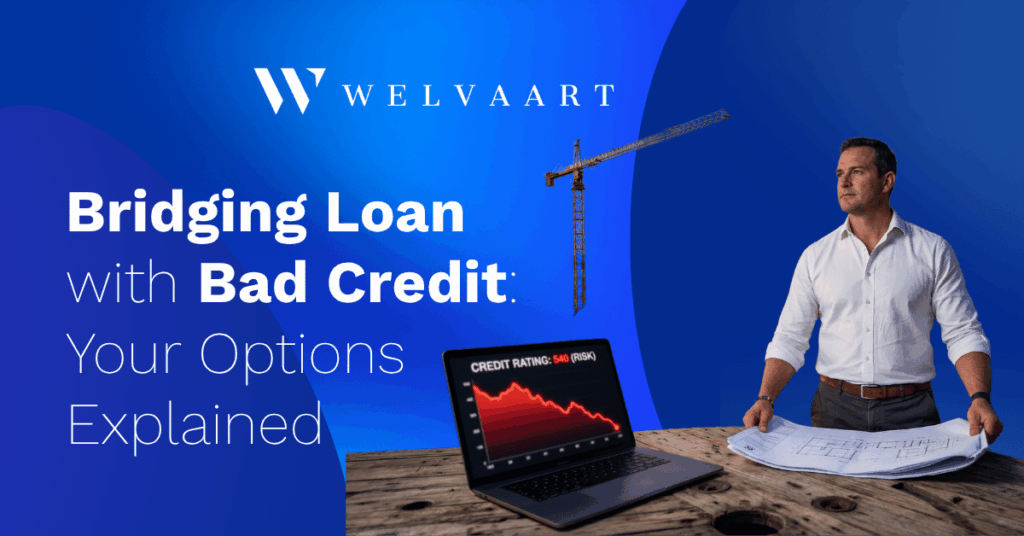
When traditional banks close their doors, many South African entrepreneurs ask a vital question. Is it possible to secure a bridging loan with bad credit?
This is a common scenario. Your business is growing, and you possess valuable assets. However, a cash flow dip or missed payments damaged your credit score. An opportunity arises requiring immediate funding. Traditional banks often look at that three-digit number and instantly deny your application.
The big banks operate under a rigid belief. They think your credit score dictates your loan eligibility. But this view is outdated for the modern business owner. You might lack liquid cash right now. That does not make your tangible assets worthless. You can be cash-poor but highly asset-rich.
So, can you get a bridging loan with bad credit? Yes, absolutely. You just need tangible assets. Alternative lenders look past the credit score. They focus on the true value of your property.
Here is exactly how securing a high-value facility works.

High-Impact Funding: The R500k Threshold
Asset-backed bridging finance does not cover small, personal emergencies. You cannot use it to borrow R10,000 to fix a vehicle. It acts as an engine for serious business growth.
Facilities start at a strict minimum of R500,000. They can scale up to R50 Million. Once your business requires funding within this tier, the evaluation process becomes incredibly straightforward. You must meet that R500,000 minimum threshold. You also need the tangible security to back it up. We then evaluate your application normally. We treat you as a viable commercial partner rather than a high-risk credit score.
The Trade-Off: Speed, Risk, and Loan Size
Traditional banks see a poor credit score and immediately decline the application. Asset-backed bridging lenders operate differently. You must understand the mechanics behind the funding.
The individual or entity providing the money takes on a significantly higher level of risk. Traditional banks never accept this risk level. In exchange for taking on that risk, two things happen:
- Unmatched Speed: We secure and deploy the funds much faster than a bank’s standard processing time.
- Higher Capital: You gain access to much higher funding amounts. Traditional channels without asset-backed lending would never approve these amounts.
The cost of the facility reflects that assumed risk. However, the rapid access to high-volume capital allows businesses to execute lucrative opportunities. You would otherwise lose these deals.
Your Assets Carry the Weight, Not Your Score
Traditional banks look strictly at your financial history. In asset-backed bridging finance, the focus shifts to the collateral.
You might own a tangible asset with genuine, provable value. This includes commercial real estate, agricultural property, or open land. If so, your credit score simply does not carry much weight. You just need solid proof of the asset’s value. That property then acts as your security.
Lenders do not demand a pristine credit record. They want to see basic, ongoing financial responsibility. You can supply your last three months of municipal statements. This usually proves you keep up with essential, day-to-day obligations.
Securing a Bridging Loan with Bad Credit: What We Look For
While a low credit score is not a dealbreaker, lenders still need to ensure the business is viable. Rather than focusing on past credit mistakes, the focus is on the current health of your operations.
- Annual Turnover: Generally, an annual business turnover of more than R1 Million is required. This shows that the business has momentum and revenue-generating capability.
- The “Hard No”: While late payments or a low score are acceptable, active liquidations are a red flag. The business must be actively operating, not in the process of being shut down.
Case Study: Funding When the Bank Says No
Consider a recent scenario involving an active property developer. He owned multiple properties. However, his recent bank statements looked weak. They failed to satisfy traditional bank requirements. Despite his tangible wealth, the bank refused to help him expand.
He possessed excellent tangible security. We looked past the messy bank statements. We used his existing real estate to secure a R500,000 loan. This bridging finance allowed him to continue building. He directly funded the growth of his core business. Traditional avenues remained entirely closed to him.

The Biggest Mistake When Seeking a Bridging Loan with Bad Credit
Business owners with poor credit eventually realize they can use assets as security. Sometimes, they eagerly offer up the wrong collateral.
The biggest mistake is trying to use primary, everyday assets as security.
Do not offer your daily vehicle or essential work equipment. This strategy is highly risky. If something goes wrong, losing those assets stops your business entirely. A strong application uses secondary tangible assets. Property or land secures the loan without disrupting your daily operations.
The Exit Strategy: How You Pay It Back
Bridging loans act as short-term solutions. They often run for about 6 months. Therefore, the “exit strategy” represents the most critical part of your application. Even with bad credit, you will give lenders confidence if you bring three things to the table:
- A Good Asset: You need unencumbered or high-equity property with provable value.
- A Clear Plan: You must define a logical reason for the funding. Explain exactly why your business needs it right now.
- Confidence in Repayment: You must present a realistic, actionable plan to settle the loan. This must happen within the 6-month window. Examples include waiting for a larger property sale or a major contract payout.
FAQ: Bad Credit Bridging Finance in South Africa
Yes. If you are seeking commercial bridging finance (starting from R500,000) and possess strong tangible assets—such as commercial real estate or agricultural property—alternative lenders weigh the value of your collateral much heavier than your credit score.
Yes. While alternative lenders can look past missed payments, a low credit score, or temporary cash flow dips, an active liquidation is generally a strict decline. To qualify, your business must be actively operating, ideally with an annual turnover exceeding R1 Million.
Strong applications use secondary tangible assets with provable, verifiable value. This includes unencumbered commercial properties, agricultural land, or high-equity real estate. You should avoid using primary, everyday assets like your daily vehicle or essential operational equipment as security.
One of the primary benefits of asset-backed bridging finance is speed. Because lenders focus on verifying the asset’s value and your exit strategy rather than conducting lengthy credit history audits, capital can be deployed significantly faster than traditional bank timelines—often within days of the final paperwork.
Alternative lenders take on significantly more risk than traditional banks, especially when funding businesses with a poor credit history. The cost of the facility reflects this risk, but it acts as a trade-off: in exchange, you gain rapid access to high-volume capital (up to R50 Million) that a traditional bank would have simply declined.
The Bottom Line
In the South African lending landscape, traditional banks rely heavily on algorithms and credit scores, which often penalize entrepreneurs who are reinvesting heavily into their businesses.
If you are a business owner seeking upwards of R500,000, do not let a poor financial history stop you from accessing capital. If you have clear business goals, an annual turnover above R1 Million, and strong tangible assets, a bridging loan with bad credit is entirely possible and can provide the rapid liquidity you need to take your next big step.